Foundations
& Principles
From integration pain to contract-based services.

Agenda for Week 1
- 01Why SOA exists — the integration problem
- 02Business and technical drivers
- 03Defining SOA and its core vocabulary
- 04Anatomy of a service
- 05SOA vs other architectural styles
- 06The eight service-orientation principles
- 07Service models and layers
- 08Granularity, coupling, cohesion
- 09Benefits, challenges, a worked example
- 10Lab 1 brief and reading
Learning Outcomes
By the end of Week 1 you will be able to:
- Explain the business and technical drivers behind SOA.
- Compare SOA with monolithic, client-server, component-based, and object-oriented approaches.
- State and explain the eight service-orientation principles.
- Identify service types and produce a first service decomposition of a business domain.
Why SOA Exists
Enterprises accumulate systems faster than they can connect them. Before defining SOA, we look at the pain it answers — and the forces pushing organisations toward it.
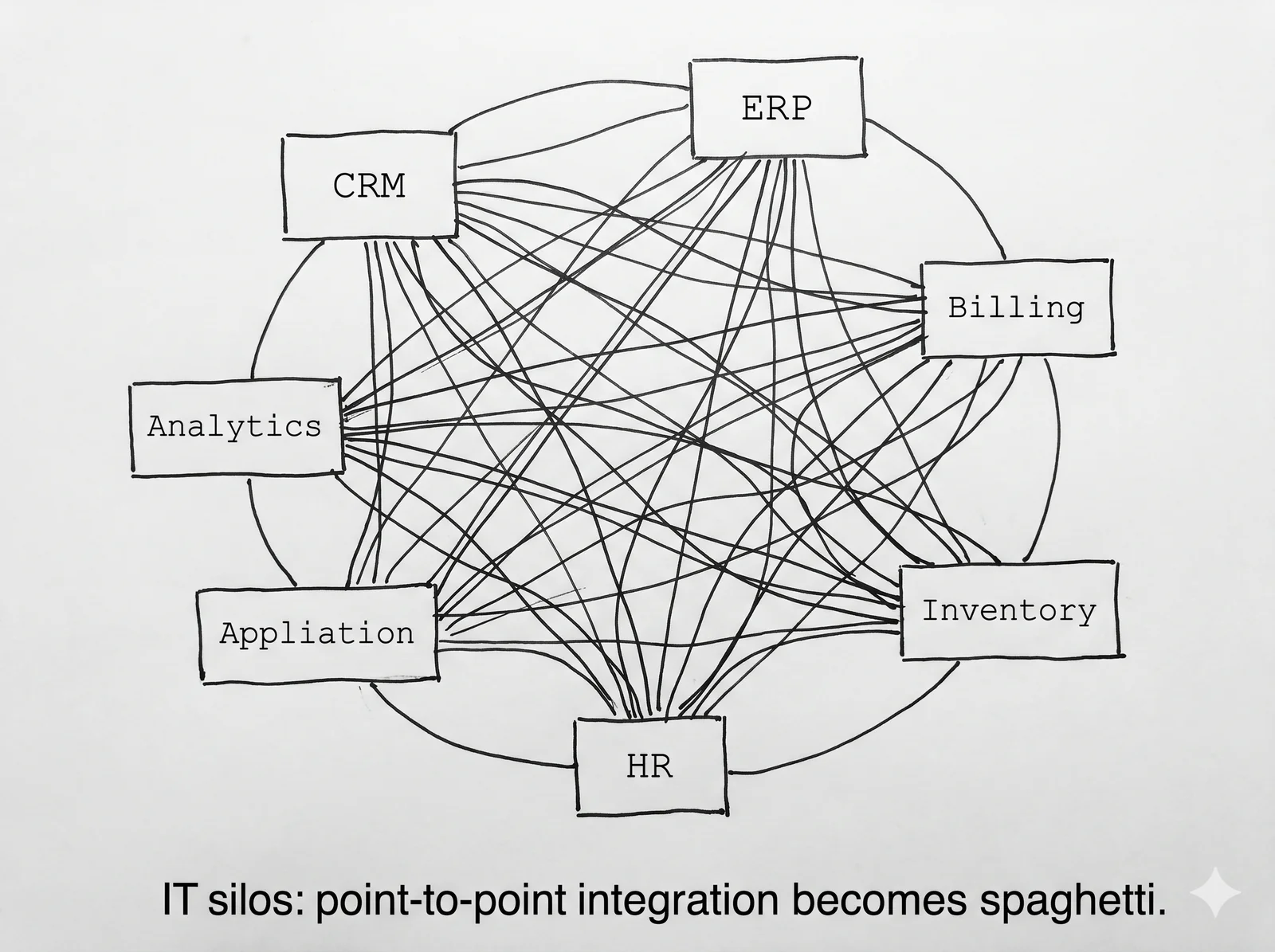
The Problem: IT Silos
Enterprises grow by adding systems over time:
- CRM, ERP, billing, inventory, HR — each built separately.
- Different vendors, languages, data models, and protocols.
- Point-to-point integrations multiply:
nsystems can need up ton(n−1)/2connections.
What Goes Wrong Without an Architecture
- Duplication: the same logic (e.g. “validate customer”) reimplemented everywhere.
- Tight coupling: changing one system breaks others.
- Poor agility: a new requirement touches many code bases.
- No reuse: functionality is locked inside applications.
- Misalignment: IT capabilities don’t map cleanly to business activities.
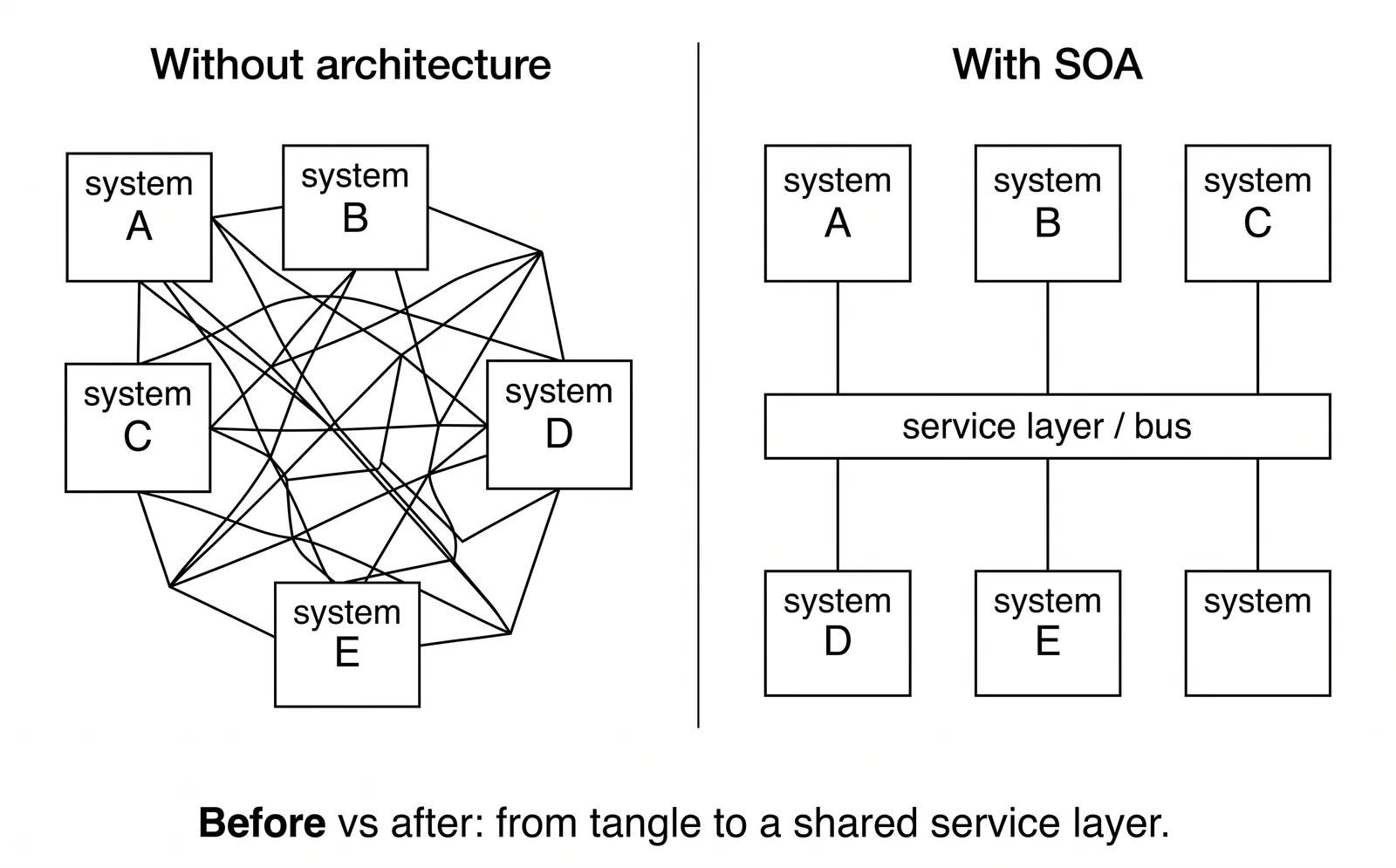
SOA is a response to all five.
Business Drivers of SOA
- Agility: respond faster to changing market and regulatory needs.
- Reuse: build a capability once, consume it everywhere.
- Cost reduction: lower integration and maintenance cost over time.
- Business–IT alignment: services map to capabilities the organisation actually recognises.
- Mergers & partnerships: easier to expose and integrate across organisational boundaries.
Technical Drivers of SOA
- Interoperability across platforms and languages via open standards.
- Loose coupling to isolate change.
- Abstraction of legacy systems behind clean interfaces.
- Standardized contracts so consumers and providers evolve independently.
- Discoverability & reuse through registries.
Defining SOA
A precise definition, the core vocabulary every service shares, and the classic find–bind–invoke interaction that ties providers, consumers and registries together.
What Is SOA?
“Service-Oriented Architecture is an architectural style in which application functionality is provided and consumed as a set of services — self-contained units of business logic exposed through well-defined, standardized contracts and accessed over a network.
SOA is a design philosophy, not a specific product or technology.
Core Vocabulary
- Service — a logical unit of functionality with a published contract.
- Service provider — exposes and hosts the service.
- Service consumer — invokes the service.
- Service contract — the agreement: operations, messages, data formats, policies.
- Service registry / repository — where services are published and discovered.
- Message — the unit of communication exchanged between consumer and provider.
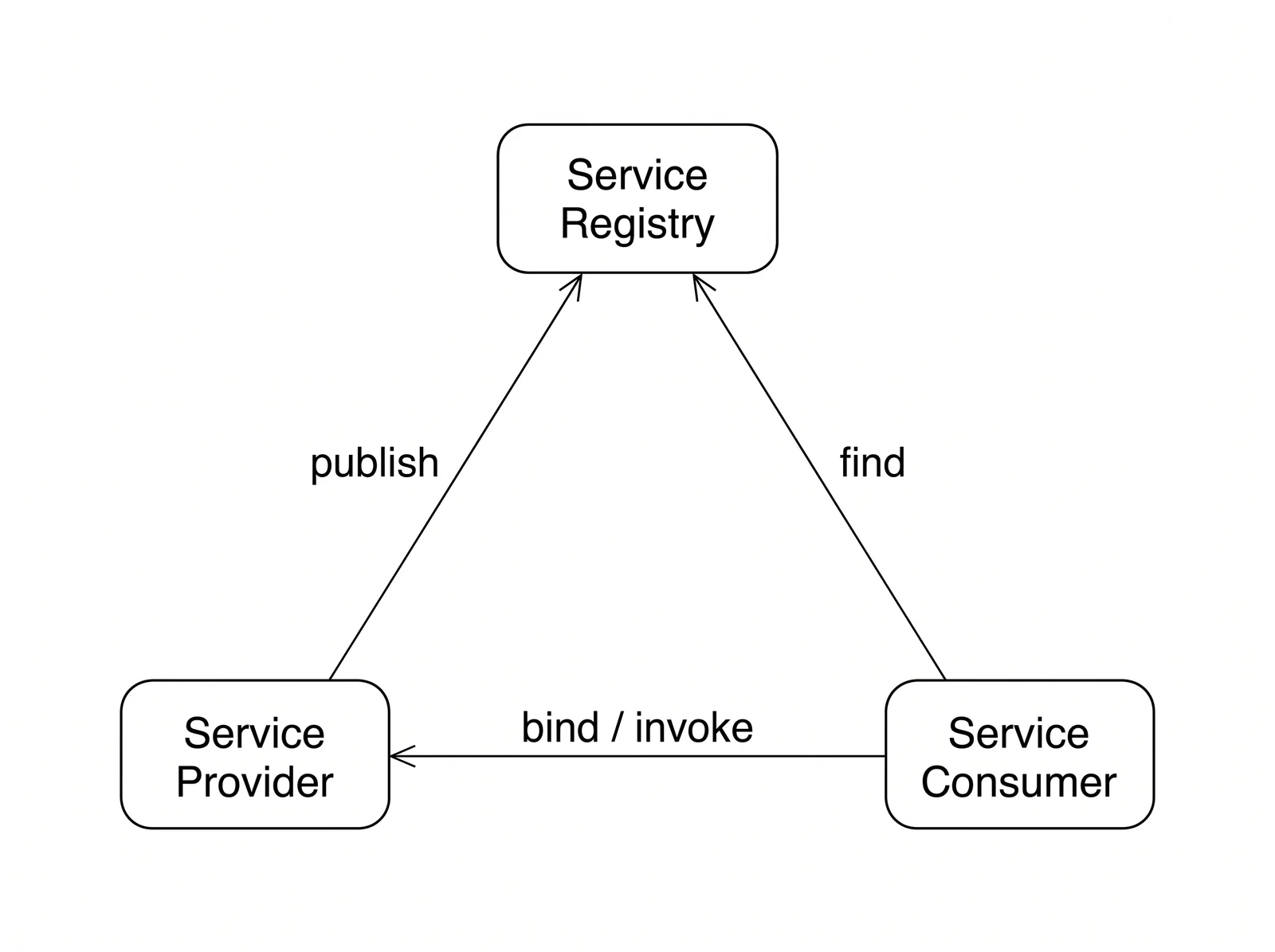
The Find–Bind–Invoke Triangle
The classic SOA interaction model:
- 01Publish — provider registers the contract in a registry.
- 02Find — consumer discovers a suitable service.
- 03Bind & invoke — consumer connects and calls the provider.
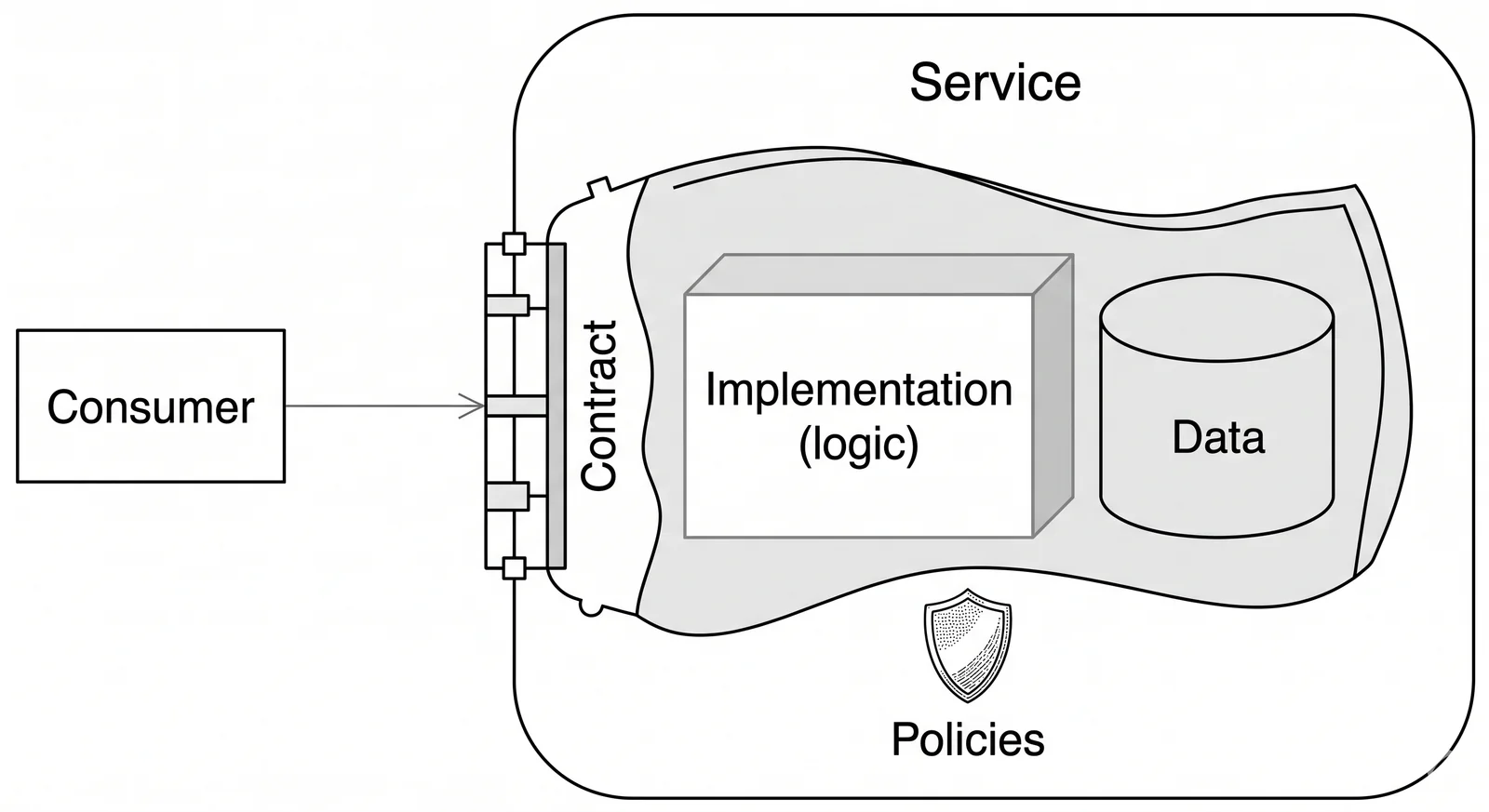
Anatomy of a Service
- Contract — what it does and how to call it (the public face).
- Implementation — the code/logic, hidden from consumers.
- Boundary — clear separation of inside vs outside.
- Data it owns or operates on.
- Policies — security, reliability, quality-of-service.
Architectural Styles
SOA did not appear from nowhere. We contrast it with monolithic, distributed, component-based and object-oriented approaches to see exactly what it adds — and what it costs.
The Landscape
We compare SOA against four reference points:
- Monolithic architecture
- Client–server / distributed architecture
- Component-based development (CBD)
- Object-oriented design (OOP)
The contrast clarifies what SOA adds and when it is worth the cost.
Monolithic Architecture
- All functionality compiled and deployed as a single unit.
- Modules call each other in-process.
Simple to build, test, and deploy initially; fast in-process calls.
Hard to scale parts independently; one change forces full redeploy; technology lock-in; coupling grows over time.
Client–Server & Distributed
- Functionality split across a network boundary (e.g. RPC, CORBA, DCOM).
- Introduced remote calls, but often tightly coupled to specific platforms and binary protocols.
Component-Based Development
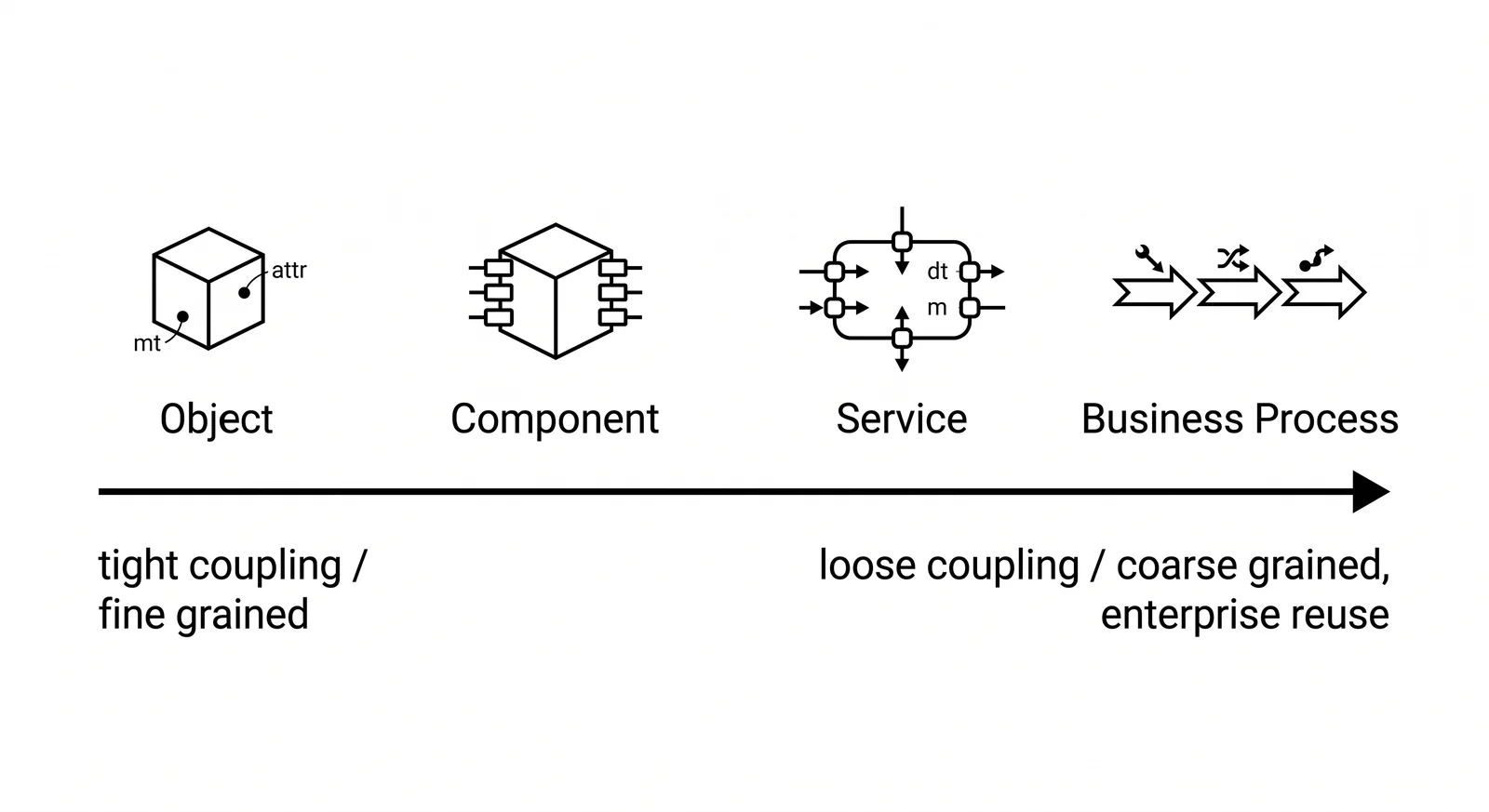
- Software assembled from reusable components with defined interfaces.
- Reuse and encapsulation at the code/binary level (DLLs, JavaBeans, EJBs).
SOA is componentization raised to the enterprise, cross-platform level.
SOA vs OOP vs CBD — At a Glance
| Aspect | OOP | Component-Based | SOA |
|---|---|---|---|
| Unit | Object/class | Component | Service |
| Coupling | Tight (references) | Medium | Loose (contract) |
| Boundary | In-process | Mostly in-process | Network |
| Reuse scope | Code | Binary/component | Enterprise/cross-org |
| Interop | Language-bound | Platform-bound | Platform-independent |
| Granularity | Fine | Medium | Coarse (business-level) |
Left → right: coupling loosens and reuse scope widens — at the cost of communication overhead.
Where SOA Fits
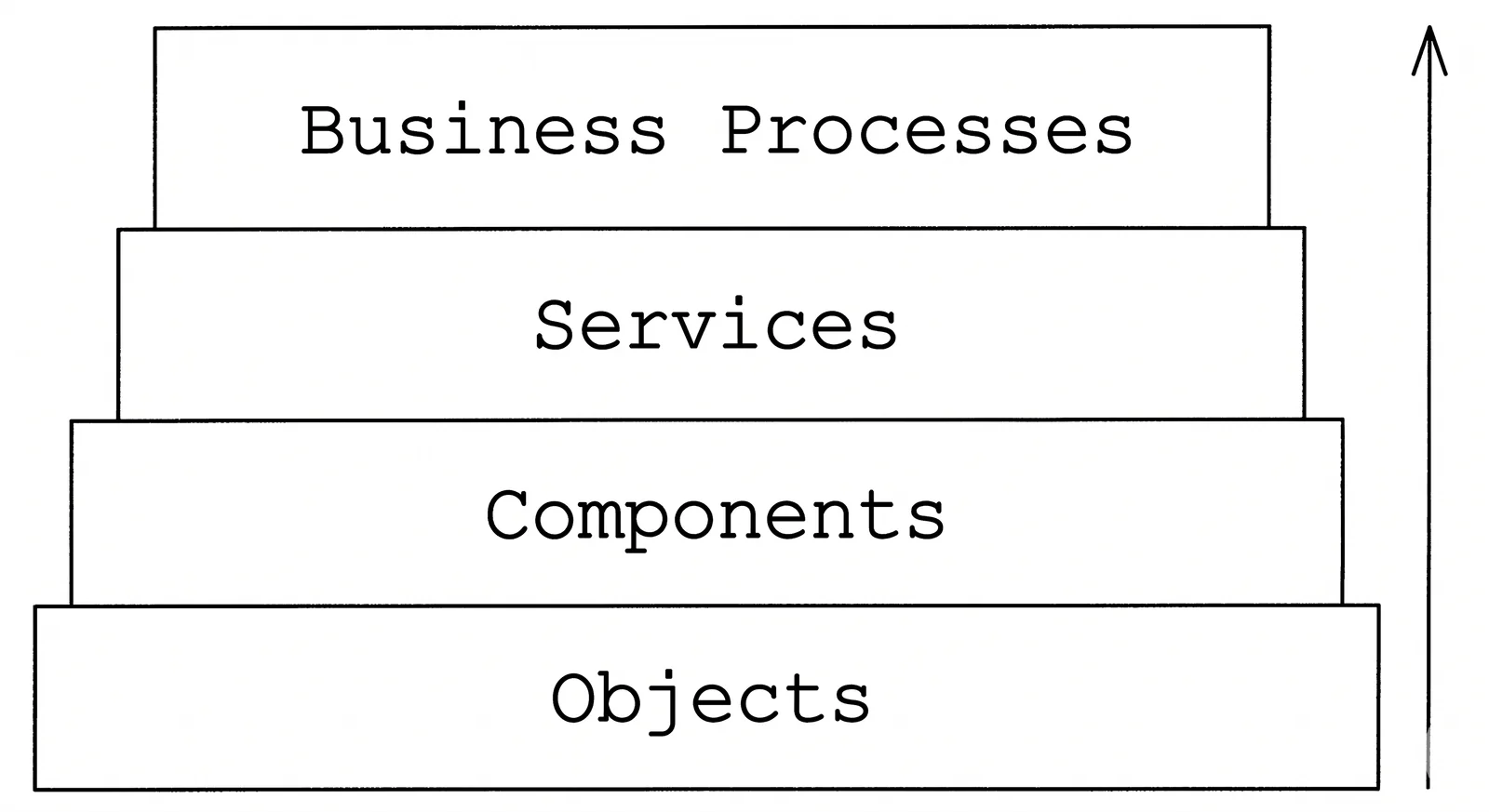
SOA does not replace OOP or components — it builds on top of them:
- Objects/components implement the logic inside a service.
- SOA governs how that logic is exposed, discovered, and combined across the enterprise.
The Eight Principles
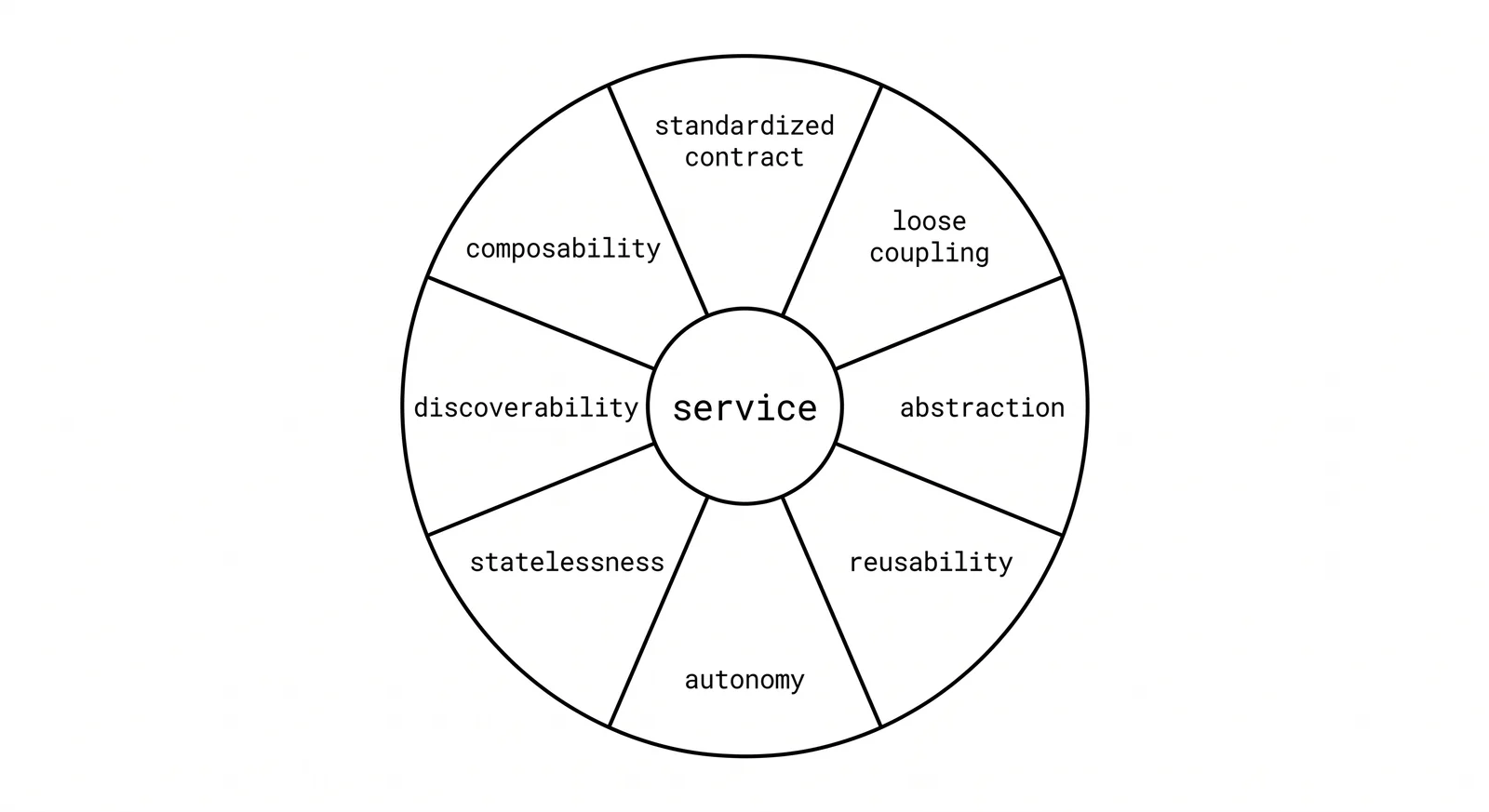
The design principles (Thomas Erl) that make a service truly “service-oriented”:
- 01Standardized contract
- 02Loose coupling
- 03Abstraction
- 04Reusability
- 05Autonomy
- 06Statelessness
- 07Discoverability
- 08Composability
Standardized Service Contract
- Services express purpose and capabilities through a formal, standardized contract.
- The contract — not the code — is the agreement with consumers.
- Consistency (naming, data models, conventions) lowers learning and integration cost.
Loose Coupling
- Minimize dependencies between a service and its consumers, and between services.
- Consumers depend on the contract — never on implementation, technology, or location.
Service Abstraction
- Hide all unnecessary details behind the contract.
- Consumers see what the service does, not how.
- Hidden: implementation logic, technology, internal data, deployment.
Reusability
- Services are designed as reusable enterprise resources, not single-use logic.
- Encapsulate agnostic (context-independent) logic so many processes can reuse it.
Service Autonomy
- A service has strong control over its own logic and environment.
- The more self-governing it is, the more reliable and predictable its behaviour.
Statelessness
- Services should minimize retained state between requests.
- State, when needed, is deferred to messages or external storage.
Discoverability
- Services are designed to be easily found and interpreted.
- Achieved via clear, documented contracts and registration in a registry.
Composability
- Services are designed to be assembled into larger compositions (business processes).
- Each service can act as a building block in many workflows.
- Bridge to Week 3: composition & orchestration.
How the Principles Reinforce Each Other
- Abstraction + standardized contract → enable loose coupling.
- Loose coupling + statelessness + autonomy → enable reuse and scalability.
- Discoverability + composability → enable agility (fast assembly of new processes).
Designing Services
How services are layered, how big they should be, and what makes the difference between SOA that pays off and SOA that becomes an expensive mess.
Service Models / Layers
A common layering of services:
- Entity services — centred on a business entity (Customer, Invoice); highly reusable.
- Task / business services — encapsulate a specific process step.
- Utility services — cross-cutting functions (logging, notification, auth).
- Orchestration services — coordinate others into end-to-end processes.
Granularity, Coupling & Cohesion
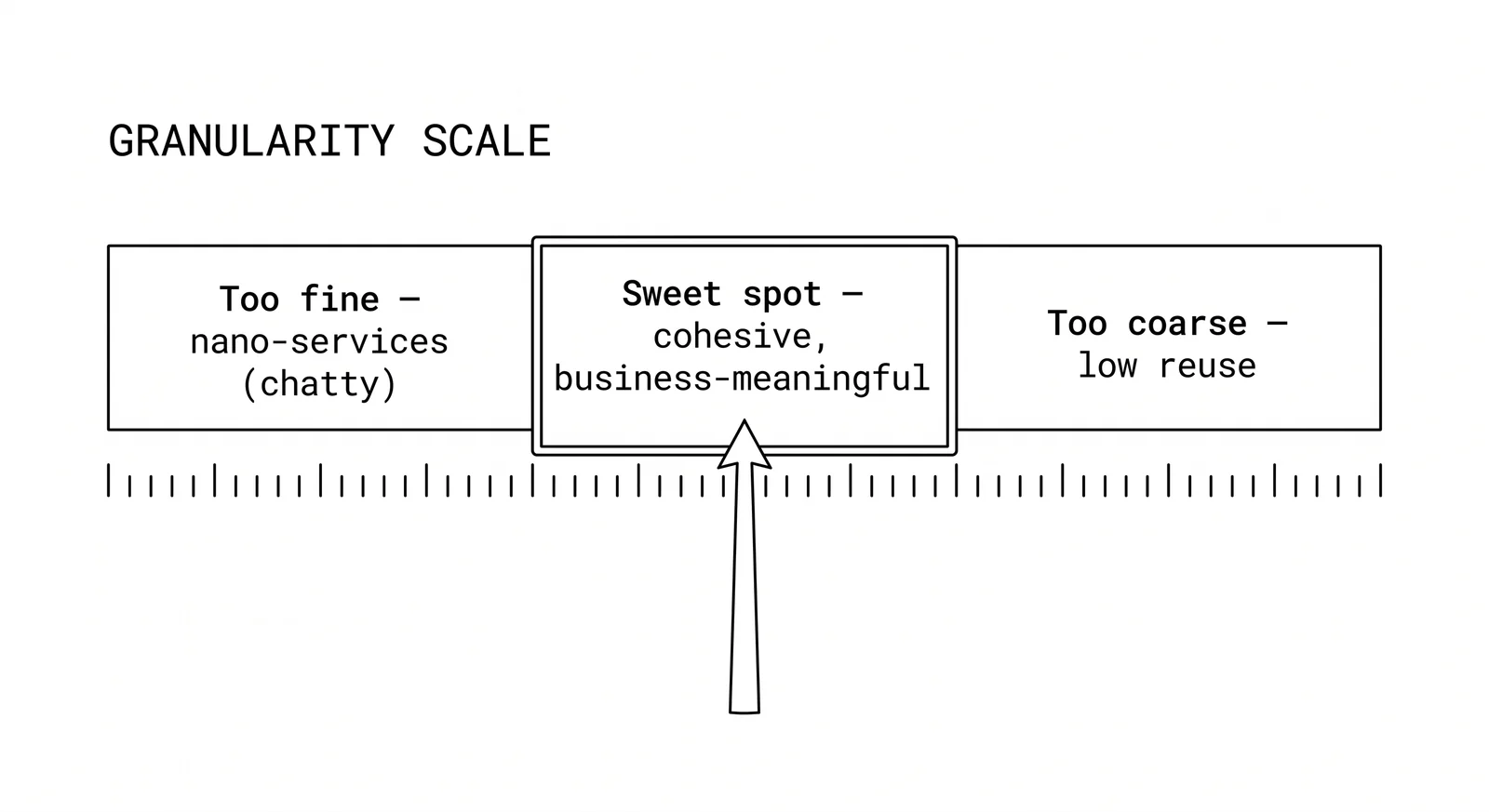
- Granularity: too fine → chatty, slow (“nano-services”); too coarse → low reuse, hard to change.
- Cohesion: a service should do one well-defined thing, fully.
- Coupling: minimize dependencies between services.
Benefits of SOA
- Increased reuse and reduced duplication.
- Greater agility — assemble new processes from existing services.
- Interoperability across heterogeneous systems.
- Encapsulation of legacy behind clean contracts.
- Better business–IT alignment.
Challenges & Pitfalls
- Upfront investment in design, governance, and infrastructure.
- Performance overhead from network calls and message processing.
- Governance is essential — without it, sprawl and duplication.
- Distributed complexity: failure handling, latency, versioning, security.
- The ESB-as-bottleneck and wrong-granularity anti-patterns.
SOA pays off at enterprise scale; it can be over-engineering for small systems.
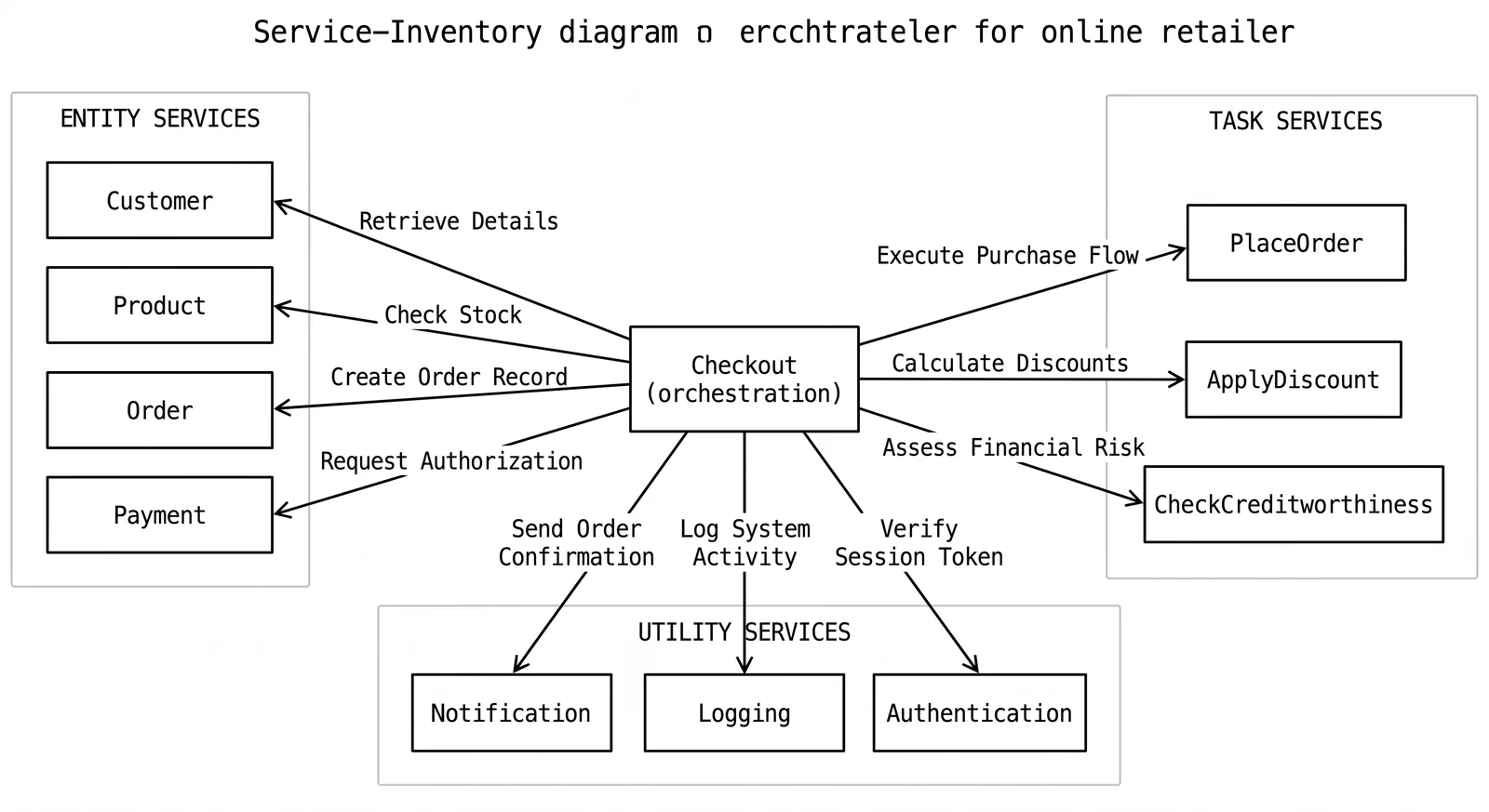
Worked Example — Online Retailer
Decompose the domain into services:
- Entity: Customer, Product, Order, Payment.
- Task: PlaceOrder, ApplyDiscount, CheckCreditworthiness.
- Utility: Notification, Logging, Authentication.
- Orchestration: Checkout composes Order + Payment + Inventory + Notification.
Online-retailer inventory composed by a Checkout process.
Lab 1 — Brief
Goal: produce a first service decomposition.
Given a business case (online retailer or university enrollment):
- 01Identify candidate services.
- 02Classify each (entity / task / utility / orchestration).
- 03Draft an informal contract per service (operations, inputs, outputs, responsibility).
- 04Justify your granularity choices.
- 05Produce a service inventory diagram.
Reading
- Erl, Service-Oriented Architecture: Concepts, Technology, and Design — introductory chapters.
- Erl, SOA Principles of Service Design — the eight principles in depth.
Key Takeaways
- SOA is an architectural style, not a product — functionality as reusable, contract-based services.
- It exists to solve integration cost, duplication, and lack of agility.
- The eight principles work together for loose coupling, reuse, and composability.
- Governance and good granularity are what make SOA succeed.
- Composability sets up everything we do in later weeks.
Week 2 — Service Technologies
- The web services stack: XML, SOAP, WSDL, UDDI.
- REST and RESTful services; JSON.
- API design and documentation (OpenAPI / Swagger).
- SOAP vs REST decision framework.
- Lab: build and consume a SOAP service and a REST service.
Questions?